Link to the article in the “Entrepreneurship, Economy and Law” Journal
The article presents an algorithm for the development of social relations in the field of tax law. The principles of tax legislation serve as such guiding mechanisms and are directly formalized in the provisions of Article 4 of the Tax Code of Ukraine. Within current legislation, principles of law may be established directly or indirectly. The relevant principles of tax legislation form a clear and coherent system. For a comprehensive understanding of this category, the article also examines doctrinal definitions of the concept of a “system.” The system of tax legislation is described through the definition of concepts and fundamental principles.
Keywords: tax law, principles, tax legislation, constitutive nature, organic unity, macrosystem, microsystem.
Statement of the Problem
To ensure the proper structuring of the development of social relations, guiding principles possessing the highest degree of imperative force must be implemented at the regulatory level. Such principles should ensure the systematization and ordering of social relations by virtue of their fundamental nature and logically determined constitutive character. The principles of tax legislation serve as such guiding mechanisms and are directly formalized in the provisions of Article 4 of the Tax Code of Ukraine.
Analysis of recent research and publications. The systemic nature of the principles of tax legislation has been examined by scholars such as S. P. Pohrebniak, A. A. Khrabrov, and O. M. Minaieva. However, certain aspects of this issue require further attention.
The purpose of this article is to analyze the systemic nature of the principles of tax legislation.
Presentation of the Main Material
It should be noted that the most systematic and comprehensive definition of principles of law was proposed by S. P. Pohrebniak. The scholar proposes understanding principles of law as a system of stable and imperative requirements that are formalized in the provisions of current legislation and may be defined as fundamental substantive characteristics which, taken together, determine the nature of the legal system, outline its inherent features, and establish prospects for its progressive development [1].
It should be noted that principles of law may be directly or indirectly enshrined in current legislation. The substance of legal principles and their nature are often clarified through judicial practice [2]. As A. A. Khrabrov notes, principles of law generally receive their formal expression in the provisions of current legislation. The scholar characterizes the role and significance of principles of law as follows:
a) they determine the substance of law;
b) they characterize the external and internal aspects of law;
c) they define law through the prism of both its dynamics and its statics.
At the same time, the scholar takes the position that principles of law are in a state of continuous development in the course of their implementation [3].
In Article 4 of the Tax Code of Ukraine, the legislature has enshrined the principles of tax legislation within a unified and coherent system whose purpose is to encompass, at the highest level of generalization, all aspects of the regulation of social relations arising in the field of taxation.
For a comprehensive understanding of this category, it is also necessary to consider doctrinal definitions of the concept of a “system.” The generally accepted approach defines a system as a set of interconnected elements that continuously interact with one another. Such a set is characterized by relative independence and organic unity, as well as by its own autonomy and internal integrity in the course of its functioning [5; 6]. Under the above approach, a system is regarded as a phenomenon of a “closed” nature. In other words, this approach does not take into account the fact that individual systems may interact with one another or with external elements that do not form part of those systems. For this reason, we note that L. von Bertalanffy, the founder of general systems theory, was more consistent in defining the substance of this category, describing a system as a complex of interacting elements that stand in certain relationships both with one another and with the external environment [7].
The system of principles of tax legislation should be understood as an interacting set of fundamental requirements of tax legislation that impose requirements of the highest degree of imperative force on activities of a constitutive and regulatory nature carried out by participants in tax relations. It should also be noted that the system of principles of tax legislation may be considered in both a narrow and a broad sense. In the narrow sense, the principles of tax legislation should be understood as the 11 requirements possessing the highest degree of imperative force that are directly formalized in the provisions of paragraph 4.1 of Article 4 of the Tax Code of Ukraine. These fundamental provisions may be defined as the named principles of tax legislation, which have been clearly identified and established by the legislature in an appropriately concise form.
When examining the substance of the fundamental principles contained in paragraph 4.1 of Article 4 of the Tax Code of Ukraine, they may be divided into constitutive and regulatory principles. In our view, principles of a constitutive nature include the following: social justice, neutrality of taxation, fiscal sufficiency, uniformity and convenience in the payment of mandatory payments, cost-effectiveness of taxation, a unified approach to establishing tax payments, and stability. Each of these principles is intended to ensure a proper and uniform approach to the legislative establishment of the elements and mechanisms for the payment of taxes and fees. These fundamental principles are intended to ensure proper tax rulemaking and establish uniform approaches to regulating the substantive aspects of mandatory tax payments.
At the same time, we may also distinguish principles of a regulatory nature, including the following: inevitability of legal liability, universality of taxation, the principle-presumption of the lawfulness of taxpayers’ decisions, and equality of taxpayers. It should be emphasized that principles of a regulatory nature are intended to ensure uniform approaches to organizing the activities of participants in tax relations. These guiding principles of tax legislation are intended to ensure the proper functioning of “living” social relations – that is, relations that currently exist in practice – in the field of taxation [8].
At the same time, it should be taken into account that Article 4 of the Tax Code of Ukraine also establishes unnamed principles of tax legislation. In particular, the regulatory provisions of Article 4 of the Tax Code of Ukraine contain at least four “hidden” principles. A. M. Kotenko defines these principles of tax legislation as unnamed principles. The scholar includes among them the principles established in paragraphs 4.2, 4.3, 4.4, and 4.5 of Article 4 of the Tax Code of Ukraine [9]. Accordingly, the scholar identifies the following principles contained in tax legislation as unnamed principles:
a) national and local taxes and fees whose collection is not provided for by the Tax Code of Ukraine are not payable;
b) tax periods and deadlines for the payment of taxes and fees are established with due regard to the need to ensure the timely receipt of funds by budgets, the convenience of taxpayers in fulfilling their tax obligations, and the reduction of tax and fee administration costs;
c) the establishment and abolition of taxes and fees, as well as tax benefits for taxpayers, are carried out in accordance with the Tax Code of Ukraine by the Verkhovna Rada of Ukraine, as well as by the Verkhovna Rada of the Autonomous Republic of Crimea and village, settlement, and city councils within the scope of their powers established by the Constitution and laws of Ukraine;
d) when new tax benefits are established or existing tax benefits are expanded, such benefits apply beginning with the following budget year [4].
As for the system of principles of tax legislation in the broad sense of the term, it should be understood as encompassing all fundamental provisions that have been established in tax legislation either directly (paragraphs 4.1–4.5 of Article 4 of the Tax Code of Ukraine) or indirectly (arising from a systemic and consistent interpretation of the provisions of tax legislation).
In general, it should be noted that the system of principles of tax legislation may be divided into three levels, each of which effectively constitutes a relatively distinct and independent system of principles. For this division, the prefixes macro-, meso-, and micro- are used to characterize the levels of functioning and structure of a particular phenomenon or field of activity. Accordingly, we distinguish a macrosystem of principles, a mesosystem of principles, and a microsystem of principles.
The macrosystem of principles of tax legislation includes all fundamental provisions established by the legislature in Article 4 of the Tax Code of Ukraine, “Fundamental Principles of Tax Legislation.” Thus, under this approach, the macrolevel of principles of tax legislation is encompassed by the concept of the “fundamental principles of tax legislation.” This level of principles includes such integrative components as the principles of tax legislation themselves (paragraph 4.1 of Article 4 of the Tax Code of Ukraine) and other fundamental provisions of tax legislation (paragraphs 4.2–4.5 of Article 4 of the Tax Code of Ukraine). In this case, we regard the macrosystem as a supersystem that incorporates the relevant integrative components.
As for the mesosystem of principles of tax legislation, we include within it the mesosystem of the principles of tax legislation themselves and the mesosystem of other fundamental provisions of tax legislation. The fundamental provisions of tax legislation forming part of the respective mesosystems may be defined as subsystems constituting components of the unified macrosystem of the fundamental principles of tax legislation. In effect, these subsystems include the subsystem of named principles of tax legislation and the subsystem of unnamed principles of tax legislation. The mesosystem forms the “intermediate” level within the systems of principles of tax legislation.
When it comes to the microsystem, its fundamental elements are determined on the basis of such a classification criterion as the direction of operation of particular fundamental provisions of tax legislation. Thus, within paragraph 4.1 of Article 4 of the Tax Code of Ukraine, we may distinguish principles belonging to the microsystem of principles of a constitutive nature and the microsystem of principles of a regulatory nature. In this case, we classify as constitutive principles such fundamental provisions as the principle of social justice, the principle of fiscal sufficiency, the principle of cost-effectiveness of taxation, the principle of uniformity and convenience in the payment of taxes and fees, and others. These fundamental provisions form a relatively independent, systemically structured group of principles through which requirements governing rulemaking activities in the field of taxation are determined. The microsystem of principles of a regulatory nature includes the principle-presumption of the lawfulness of taxpayers’ decisions, the principle of inevitability of legal liability, the principle of equality and non-discrimination of taxpayers, and others. These principles of tax legislation have a specifically oriented purpose consisting in ensuring proper application of law in the field of tax law. In effect, these microsystems constitute integrative components of the mesosystem of the principles of tax legislation themselves – the named principles.
We consider it appropriate to note that this systemic interaction among the fundamental principles of tax legislation is based on the logic that each higher-level system “absorbs” lower-level systems. This reflects the mutual integration of the respective systems. Such mutual integration operates in an ascending order, that is, from the microsystems toward the macrosystem. It should also be noted that the macrosystem is the highest-order system, integrating all fundamental provisions of tax legislation. In any event, however, it must be clearly understood that this division is conditional. Our structuring and division of the systems of fundamental provisions of tax legislation is intended to visually demonstrate the complex and multilevel nature of the interaction among the principles under examination (see Fig. 1).
It should be noted that the multiplicity of systems of fundamental provisions of tax legislation does not disrupt the logic governing the functioning of the respective individual systems. Each of the above systems of principles of tax legislation retains its own specific characteristics and relative independence. At the same time, we emphasize that these systems continuously interact with one another. Each is mutually integrated with the others, thereby complementing them substantively. Despite the multiplicity of systems of principles of tax legislation and the complexity of their interaction, each respective system retains its distinct identity and independence. The non-uniform nature of the system of principles of tax legislation results in greater structural complexity of the phenomenon under examination, thereby clearly demonstrating its multifaceted and multidimensional nature.
In general, it should be noted that the system of fundamental principles of tax legislation is characterized by a high degree of stability. This is due, in particular, to the fact that the relevant principles are characterized by the established and universal nature of the imperative requirements embodied in them. It is also important that, from the standpoint of legislative drafting, the formulation of fundamental regulatory provisions is generally accompanied by structural changes within particular institutions of a specific branch of legislation.
This aspect necessitates a balanced approach to modernizing a particular system of fundamental provisions, including the system of principles of tax legislation.
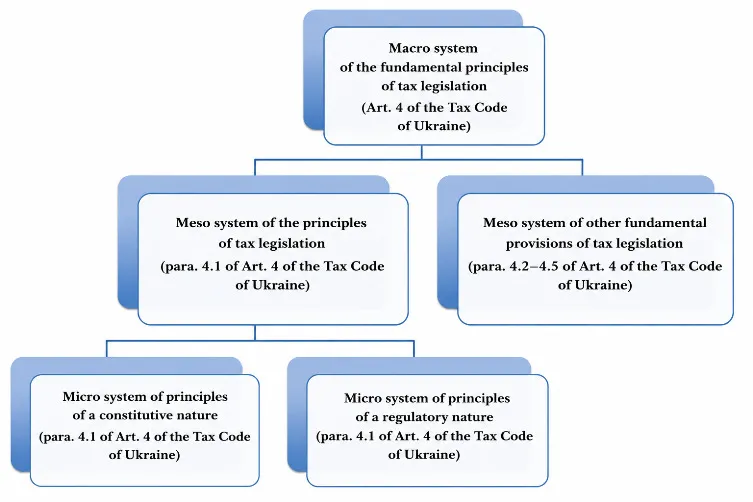
Fig. 1. Structure of the Systemic Interaction Among the Fundamental Principles of Tax Legislation
At present, the question remains relevant as to whether principles of tax legislation that are not directly enshrined may be included in the system of fundamental principles of tax legislation. In this regard, we take the position that such fundamental provisions, which may be identified through a systemic and consistent interpretation of the provisions of tax legislation, also fit organically within the system of fundamental provisions of tax legislation, while occupying a somewhat specific position because they are derived through a complex process of systemic and analytical interpretation.
Conclusions
It should be noted that the principles contained in tax legislation ensure the performance of systematizing and stabilizing functions. With regard to the stabilizing function of the fundamental ideas of law, it should be noted that this function manifests itself in establishing and embedding requirements that demand unconditional compliance, response, and implementation – in other words, imperative requirements aimed at maintaining stability in the development of the field of tax law. The principles contained in tax legislation serve as a framework for the entire field of taxation, thereby making it possible to maintain continuity and a certain degree of predictability in the development of relations in the field of taxation.
As for the systematizing function, its substance lies in the fact that the principles reflected in tax legislation ensure the comprehensive and consistent regulatory effect of the legal acts forming part of tax legislation. In essence, the fundamental guiding ideas enshrined in tax legislation make it possible to integrate all regulatory tax provisions into a coherent regulatory framework.

References and Sources:
- Pohrebniak S. P. Fundamental Principles of Law (Substantive Characteristics): Monograph / S. P. Pohrebniak. – Kharkiv: Pravo, 2008. – 240 p.
- Kashanina T. V. Legal Technique: Textbook / T. V. Kashanina. – Moscow: Norma – Infra-M, 2011. – 496 p.
- Khrabrov A. A. Legal Regulation of the Principles of Tax Law (Theoretical Aspect) / A. A. Khrabrov // Essays on Contemporary Tax Law Scholarship: Monograph / general ed. E. Yu. Gracheva and N. P. Kucheriavenko. – Moscow; Kharkiv: Pravo, 2013. – pp. 47–62.
- Tax Code of Ukraine: Law of Ukraine No. 2755-VI dated December 2, 2010.
- Afanasiev V. G. Systems and Society / V. G. Afanasiev. – Moscow: Politizdat, 1980. – 368 p.
- Encyclopedic Dictionary of Philosophy / editorial board: S. S. Averintsev et al. – 2nd ed. – Moscow: Soviet Encyclopedia, 1989. – 815 p.
- Bertalanffy L. General System Theory – A Critical Review / L. von Bertalanffy // General Systems. – 1962. – Vol. 7. – pp. 1–20.
- Minaieva O. M. Procedural Regulation of Tax Relations (Methodological Aspect): Dissertation for the Degree of Doctor of Legal Sciences / O. M. Minaieva. – Zaporizhzhia, 2017. – 402 p.
- Kotenko A. M. On the Issue of Principles in Tax-Law Regulation / A. M. Kotenko // Financial Law. – 2014. – No. 2. – pp. 22–24.